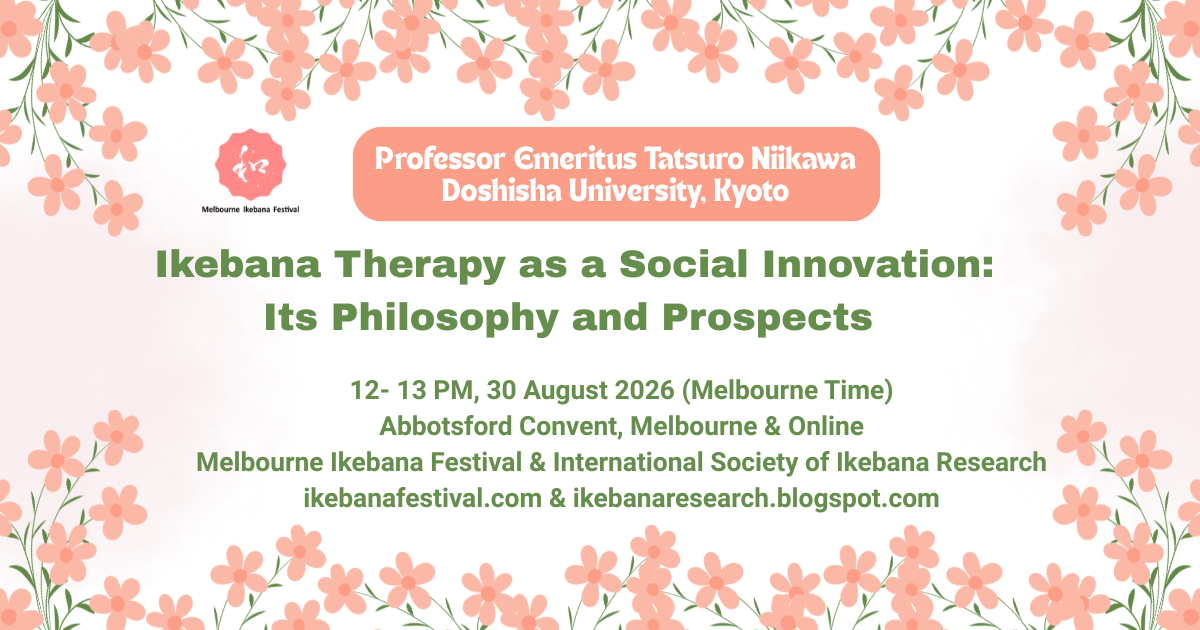
Wa: Melbourne Ikebana Festival is pleased to host a regular conference of the International Society of Ikebana Research (ISIR).
ISIR 46th Regular Conference
Ikebana Therapy as a Social Innovation: Its Philosophy and Prospects
When: 12 - 13 PM (Melbourne Australia Time), Sunday 30 August 2026.
Where: Store, Abbotsford Convent, Melbourne & Online
How to Join: (1) Book an in-person session from Melbourne Ikebana Festival's website ($20) or
(2) Send a form and receive a free Zoom link. We welcome 500 Yen donation (see the end of this page).
Notes: The participants of Ikebana Therapy Guide Certification Course don't need to book this presentation. Your course fee includes the fee for this session.
Welcome: Dr Osamu Inoue - President of ISIR, Professor - Kyoto Saga University of Arts
MC: Shoan Lo - Secretary of International Society of Ikebana Research, Associate Director of Ikebana Gallery Award & Ikebana Dojo. Director of Melbourne Ikebana Festival
Presenter: Professor Tatsuro NIIKAWA, President of the Japan Ikebana Therapy Association, Professor Emeritus, Doshisha University
Abstract:
Ikebana, a traditional Japanese art, is not only well-known throughout the world but also has attracted many practitioners and admires. Over its 400-year history, the artistry and spirituality of Ikebana have been refined.
However, the practice of Ikebana, which has focused narrowly on Ikebana as simply arranging flowers, has also limited its social relevance and developmental potential. We believe that rediscovering the social aspects of Ikebana flower arranging and creating new avenues for its development will lead to the advancement of Ikebana in modern society.
To restore the social dimension of Ikebana and promote its development, we have devised and are implementing “Ikebana Therapy.” We have decided to explore the potential of Ikebana as a therapeutic method for the various pathologies—whether personal or social—that citizens face in modern society. In doing so, we developed “Ikebana Therapy” as a method through which Ikebana flower arranging can heal and enrich people’s minds and hearts, while simultaneously restoring and revitalizing physical functions.
In fact, “Ikebana Therapy” has undergone repeated clinical trials as a non-pharmacological treatment for dementia. There are already records showing that it has been practiced by tens of thousands of people. Furthermore, based on our current efforts, we have found that it can help bring out the abilities of people with various disabilities—whether they are adolescents in their developmental stages or adults—and empower them toward growth and maturity.
“Ikebana Therapy” can be regarded as a social innovation needed by contemporary society and its future. Social innovation is an activity aimed at transforming people and society for the better; it involves setting new social goals, providing innovative methods to achieve them, and creating new values for citizens and society— it is a challenge undertaken for this very purpose. Our goal is for these social innovation activities to spread widely, thereby reshaping society as a whole toward an ideal future.
“Ikebana Therapy” is a social innovation that solves various challenges faced by citizens and society, realizes people’s well-being, and creates a better society. Therefore, “Ikebana Therapy” must refine both its theory and practice to a high standard and implement them socially. The Japan Ikebana Therapy Association is responsible for the education and research required for this, while the Flower Psychology Association is responsible for technical development and practical application.
In this presentation, we aim to clarify the theoretical framework of “Ikebana Therapy” as a social innovation and present the specific prospects it seeks to open up.
Keywords; Ikebana, Ikebana therapy, Social innovation, Well-being,
ソーシャル·イノベーションとしてのいけばな療法:その理念と展望
新川 達郎 日本いけばな療法学会会長 同志社大学名誉教授
日本の伝統芸術である「いけばな」は、世界中によくしられているだけではなく、多くの愛好者を魅了している。「いけばな」が持つ歴史と伝統は、400年以上の歴史の中で、その芸術性と精神性を彫琢されてきている。
しかしながらその一方では、「花を活ける」ことに焦点を絞った「いけばな」の実践は、いけばなの社会性や発展可能性を制約することにもなってきた。花を活けることの社会性を再発見し、その発展可能性を創造していくことが、「いけばな」を現代社会において発展させることになると我々は考えている。
いけばなの社会性を回復し、その発展を目ざすために、われわれは、「いけばな療法」を考案し、実践することにした。現代社会において市民が直面する様々な病理に対して、個人的であれ社会的であれ、治療法としての「いけばな」の可能性を追求することにした。そこでは、「花を活ける」ことが人々の心を救い豊かにしていくこと、そして同時に身体機能の回復や活性化をもたらすことができる方法として、「いけばな療法」を開発したのである。
実際に「いけばな療法」は、認知症に対する非薬物療法としての治験を重ねてきている。すでに数万人を超える実践の記録がある。さらに、私たちが試みているところでは、様々な障害を持った人々にたいして、それは発達期にある青少年であれ成人であれ、その能力を引き出し、成長と成熟に向けての力づけをしていくことができるのである。
「いけばな療法」は、現代社会とその未来が必要とするソーシャル·イノベーションと考えることができる。ソーシャル·イノベーションは、人々とその社会をよりよく変えていくための活動であり、新たな社会目標を措定し、その実現に向けての革新的な手法を提供し、市民とその社会に新たな価値を創出する活動であり、そのための挑戦である。そしてこうしたソーシャル·イノベーションの活動が大きく広がって、社会全体を理想の未来に組み替えていくことを意図している。
「いけばな療法」は、市民とその社会の様々な課題を解決し、人々のウエルビーイングを実現し、よりよい社会を創出していく、ソーシャル·イノベーションである。そのため、「いけばな療法」は、その理論と実践を共に完成度の高いもににし、社会的に実装していかなければならない。そのための教育と研究を担うのが「いけばな療法学会」であり、技術開発や実践を担うのが「フラワーサイコロジー協会」である。
本報告では、ソーシャルイノベーションとしての「いけばな療法」について、その理論体系の概要を明らかにし、具体的にどのような展望を拓こうとしているのかを提示することにしたい。
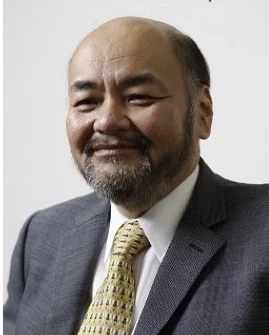
Professor Tatsuro Niikawa
Ph.D. in Political Science, Waseda University. Former Associate Professor at Tohoku University and Professor at Doshisha University.
Currently Professor Emeritus at Doshisha University, Visiting Professor at the Research Institute for Humanity and Nature and Kansai University, and President of the Japan Ikebana Therapy Association. Also chairs several public and community organizations in Kyoto.
Expertise: Public administration, local governance, public policy, civic participation, and social innovation.
Key Works:The World of Ikebana Therapy, Dynamic Studies on Public Governance, Introduction to Policy Studies, Theory and Practice of Social Innovation, among others.